Brabus Bodo: V12 supercar marks the leap from tuner to manufacturer
With the Bodo, Brabus is putting its first standalone supercar on the road. The V12 two-seater is loud, uncompromising, and strategically more important than another Mercedes-based conversion.
Brabus Bodo: its own car instead of just an extreme conversion
For the brand from Bottrop, the Brabus Bodo is more than another very fast, very loud, and very striking car. It is Brabus’s first standalone supercar and thus a strategic step that takes the company beyond the classic role of a refinement specialist. Instead of radically modifying an existing Mercedes model, Brabus is entering the field here with its own sports car concept.
The name was chosen deliberately: Bodo refers to company founder Bodo Buschmann, who made Brabus one of the best-known names in high-performance tuning and died in 2018 at the age of 62. The idea of its own sports car accompanied the brand for many years. Now it is becoming reality under the next generation of leadership.
Why this car matters

For buyers in the extreme luxury and supercar class, performance is not the only thing that counts. Exclusivity, provenance, brand identity, and collector potential are often just as important. This is exactly where the Bodo aims to start. A converted flagship model from an established manufacturer can be fast and desirable, but at its core it remains a derivative. A standalone supercar changes the perception of the brand.
For Brabus, this means: the Bodo is intended to show that the company can do more than make what others have developed faster, wider, and louder. It is meant to prove that Brabus itself can appear as a low-volume manufacturer – with its own product, its own design language, and its own positioning.
This is also interesting for the industry. While many manufacturers increasingly define performance through electrification, hybrid drives, and software, Brabus is deliberately relying on a V12 here. This is not a mainstream signal, but a statement for a small customer group that values mechanical opulence, sound, and tradition more highly than efficiency or electric range.
V12 as a deliberate counterproposal

The most important technical statement about the Bodo is its twelve-cylinder engine. Concrete performance figures, production numbers, and prices are not reliably stated in the available information, so any precise number would be speculation. What is clear, however, is this: a V12 in a new supercar is an exceptional phenomenon in 2026.
This is not only due to emissions regulations. Large combustion engines are expensive to develop, homologate, and produce. At the same time, the market for such vehicles is shrinking. Many brands are turning to smaller engines with electric assistance or directly to battery-electric high-performance powertrains. With the Bodo, Brabus is choosing a different path: less rational, more emotional, clearly tailored to enthusiasts.
That fits the brand’s history. Brabus did not become known through restraint, but through extreme performance increases, dark aesthetics, loud appearances, and very high detail quality. The Bodo transfers this DNA into a car that is no longer meant to be understood merely as an interpretation of someone else’s production model.
Design: low, dark, offensive
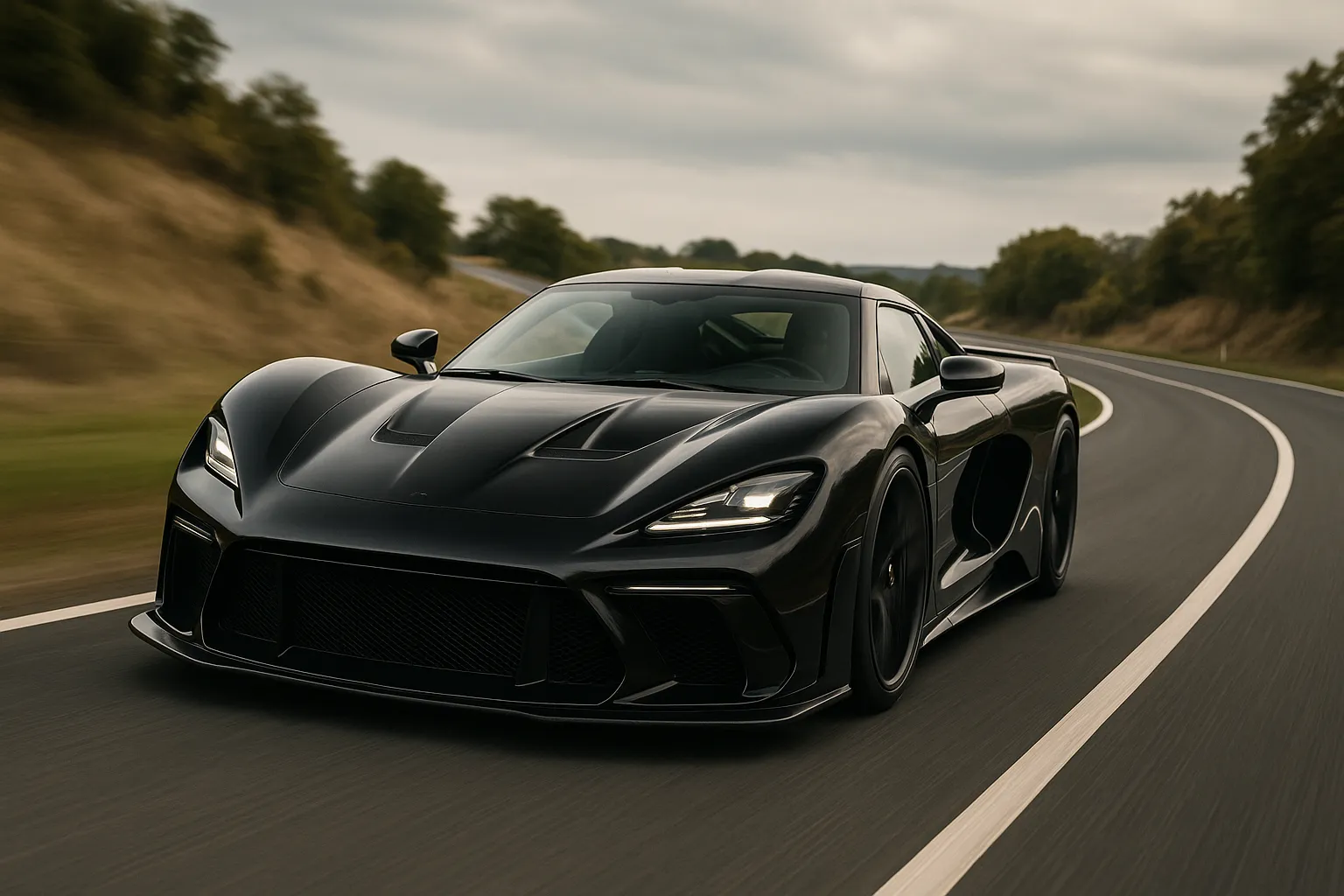
The Bodo is described as a low-slung, black, and emphatically aggressive-looking supercar. This is not a minor detail, but part of the brand logic. Brabus customers usually do not expect discreet understatement in the classic sense. They buy presence.
A car like the Bodo must therefore make clear even when stationary that it does not fall into the category of normal sports cars. Low proportions, a wide track, large air intakes, and visibly performance-oriented aerodynamics are likely to be decisive for its effect. The visual appearance therefore follows what Brabus has cultivated for decades: technical toughness, luxury, and maximum road presence.
That can polarize. For some buyers, precisely this bluntness is the appeal. Others will perceive it as too loud in the figurative sense. But in the price class in which such cars are expected, polarization is not a flaw. A supercar does not have to please everyone; it has to strongly appeal to the right small target group.
From Mercedes specialist to broader luxury brand
Brabus remains closely connected with Mercedes. The business with refined Mercedes models continues to form an essential part of its identity and day-to-day operations. At the same time, the brand has positioned itself more broadly in recent years. In addition to cars, Brabus now also appears in areas such as boats, motorcycles, motorhomes, and real estate.
The Bodo fits into this development. It is not a break with the past, but an intensification. The message is: Brabus does not only want to offer accessories, performance upgrades, and complete conversions, but to create an independent luxury world. Its own supercar is a particularly visible symbol of that.
For existing Brabus customers, this can enhance the brand. Anyone who already owns a refined G-Class, SL, or other high-performance conversions may see the Bodo as the peak of the brand hierarchy. For new customers who have previously been more focused on Ferrari, Lamborghini, McLaren, Aston Martin, or Pagani, however, Brabus must prove that its own car offers the same depth in driving dynamics, craftsmanship, and durability.
First driving impressions: character instead of restraint
In initial driving assessments, the Bodo is described as very convincing. Its volume, power, and unabashed aggressiveness are highlighted in particular. That sounds like a car that does not try to conceal its performance. Rather, the driver is meant to constantly feel that an extreme twelve-cylinder sports car is at work here.
For enthusiasts, that is a central point. Modern supercars are often incredibly fast, but also increasingly digital, filtered, and predictable. A V12 supercar from Brabus promises a different experience: more noise, more mechanical presence, more drama.
Whether that is pleasant in everyday use is another matter. Buyers of such vehicles may expect luxury, but they often accept compromises in comfort, visibility, and everyday usability if the emotional experience is right. This is exactly the balancing act the Bodo has to master: it may feel raw, but not unfinished; extroverted, but not crude.
What buyers should consider
Interested buyers should not view the Bodo like a normal luxury car. With low-volume supercars, service access, spare parts supply, resale value, and long-term brand strategy count alongside purchase price and performance. A first standalone model can be especially desirable, but it also carries the risk that teething troubles or low production numbers make upkeep complex.
On the other hand, precisely this uniqueness can create the appeal. If Brabus builds the Bodo in very limited numbers, it is likely to appeal above all to collectors who already own several high-performance cars and are looking for something that is not found in every luxury garage.
The classification of the V12 is also important. Anyone who values future-proofing in cities, low running costs, or electric everyday usability is in the wrong place here. Anyone, however, looking for an emotional collector’s item from the late era of large combustion engines will find a very clear proposition in the Bodo.
Conclusion
The Brabus Bodo is not simply another extreme car from Bottrop. It stands for the attempt to permanently establish Brabus as an independent low-volume manufacturer in the supercar segment. With V12 power, an uncompromising appearance, and a close connection to the brand’s history, it is a deliberately emotional product in an increasingly electrified industry.
For buyers, the Bodo is especially interesting if they value exclusivity, mechanical character, and brand story more highly than sober efficiency. For enthusiasts, it is a rare new V12 signal. For the industry, it shows that even in 2026 there is still room for radical combustion-engine low-volume production – not as a mass-market solution, but as a luxurious niche with strong symbolic power.