Toyota patent points to compact pickup with clever tailgate
A new patent application shows how Toyota could create additional cargo space in a possible Ford Maverick rival: with a hidden tailgate solution that is used only when needed.
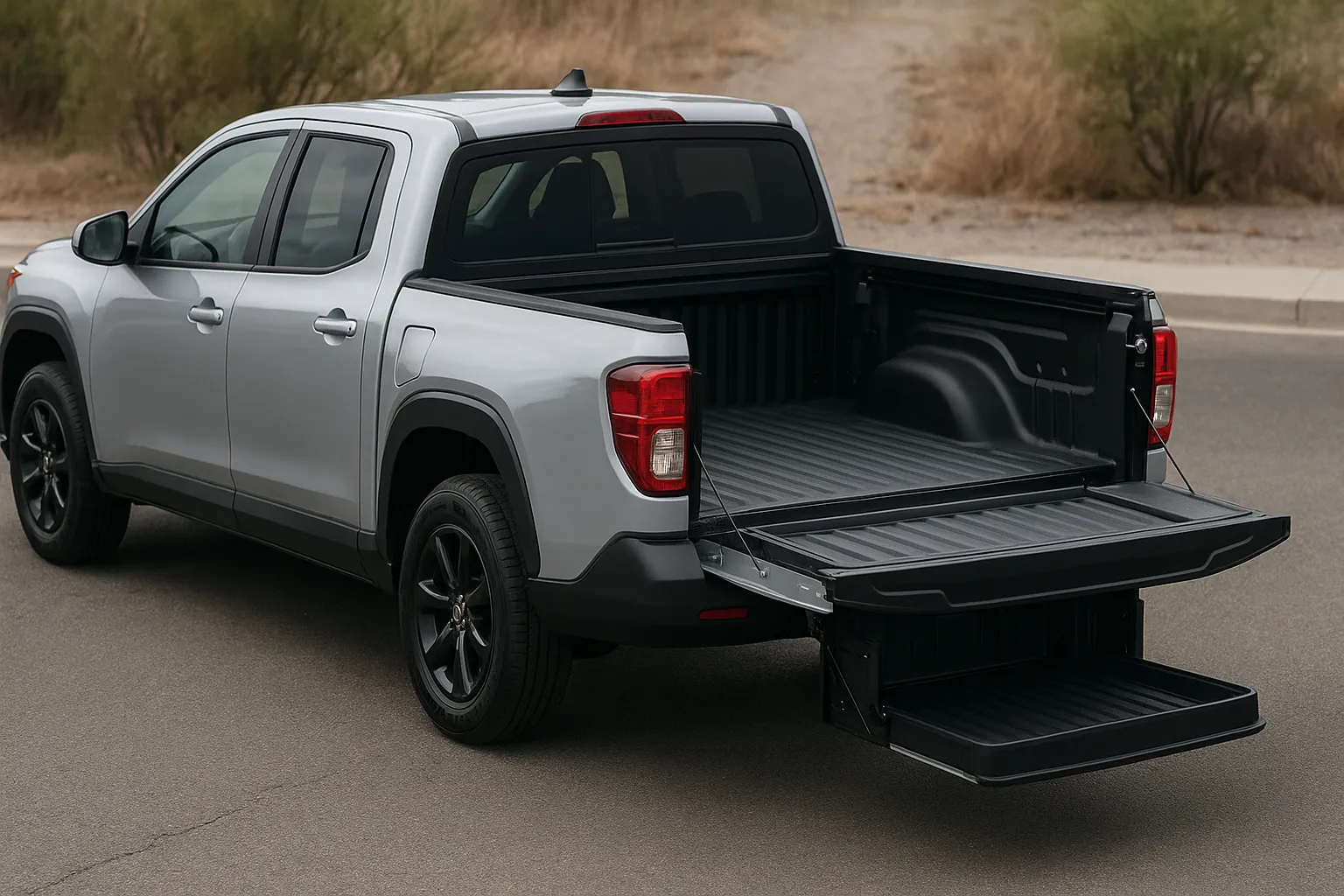
Toyota could be preparing an unusually practical tailgate solution for a future compact pickup. A newly published patent application describes a hidden function in the tailgate area intended to create additional usable cargo space when needed. This once again brings the question to the fore of whether Toyota is planning a smaller pickup below the Tacoma – and how such a vehicle could compete against the Ford Maverick.
The context is important: A patent application is not a model announcement. Manufacturers regularly protect technical ideas, some of which never enter series production. Nevertheless, the application shows what Toyota is working on from an engineering perspective: more everyday usability for a short cargo bed without making the vehicle permanently larger, heavier, or more cumbersome.
What the tailgate idea is meant to achieve

At its core, it involves a component that is hidden in the rear area and is only extended, folded out, or otherwise activated when more cargo bed length is needed. The exact production design has not been confirmed, but the principle is clear: A compact pickup should remain compact in everyday use, but provide additional space at short notice for longer items.
This is particularly relevant for small pickups. A vehicle in the size class of a Ford Maverick is not intended to replace a large workhorse such as a full-size pickup. Its appeal lies in the mix of car-like driving behavior, manageable exterior dimensions, relatively low fuel consumption, and an open cargo bed for leisure, DIY, or light commercial use. The downside is a shorter cargo bed. That is exactly where an intelligent tailgate can make the difference.
For buyers, this could mean: bicycles, boards, camping equipment, garden materials, or longer boxes can be transported more safely without immediately having to opt for a larger and more expensive pickup. For owners who only occasionally need more cargo volume, an integrated solution would be more attractive than accessories that have to be mounted, stored, or secured separately.
Why Toyota is likely to be examining a Maverick rival

The Ford Maverick has shown that there is room in North America for a smaller, more affordable pickup with everyday practicality. Its success is not only down to price, but also to the concept: four doors, a practical cargo bed, compact proportions, and powertrain options aimed more at crossover customers than traditional truck buyers.
Toyota is strongly positioned in the pickup business, but in the U.S. there is a gap below the Tacoma. The Tacoma is a true midsize truck with the corresponding size, capabilities, and price level. The Tundra covers the large segment. A smaller Toyota pickup could appeal to customers who are currently weighing compact SUVs, used pickups, and a Maverick.
For Toyota, such a move would be strategically interesting. The brand has a large loyal customer base, a reputation for durability, and experience with hybrid powertrains. A compact pickup in particular with an efficient powertrain and a clever cargo bed solution could appeal to both private buyers and fleet customers. Whether a future model would actually be offered as a hybrid, purely electric, or with a conventional combustion engine, however, remains open. The patent application itself confirms no powertrain, no platform, and no market launch.
Utility is decisive in the small pickup segment
With large pickups, towing capacity, body-on-frame construction, maximum payload, and off-road capability often play the main role. With compact pickups, the focus shifts. What matters here is whether the vehicle fits in a garage, is not annoying in city traffic, remains economical, and can still do more than a normal crossover.
A hidden tailgate function fits exactly into this requirement profile. It would mitigate the everyday compromise that results from short exterior dimensions. A buyer would not have to live permanently with a longer vehicle, but would have a better way to load longer items when needed. For leisure users, this can be just as important as it is for tradespeople who do not need a large commercial vehicle.
The idea is also interesting from the industry's perspective. Manufacturers are increasingly looking for ways to make smaller vehicles feel more valuable and versatile without significantly increasing cost and weight. An integrated cargo bed extender could serve as a differentiating feature – especially when competitors offer similar vehicle sizes, similar prices, and comparable powertrains.
Many questions still unanswered
It remains unclear whether the patented solution is intended for a specific production model or merely secures a technical option. Nor are dimensions, load capacity, locking, weather protection, or possible safety functions known. Especially with a tailgate solution, these points are crucial: Such a system would have to be stable enough for real loads, easy to operate, and comply with legal requirements for lighting, license plate position, reversing camera, and load securing.
The name of a possible compact Toyota pickup has also not been confirmed. In the past, various historical or speculative names have been associated with a small Toyota truck, but reliable production information is not available. The only certainty is this: The patent application fits a vehicle concept that would make sense below the Tacoma.
What this means for buyers
Anyone currently looking for a compact pickup should view this development as an indication, but not as a basis for a purchase decision. A patent is no substitute for a production plan. In the short term, nothing changes about the available models. In the medium term, however, it shows that Toyota is seriously thinking through the subject of a small pickup and a flexible cargo bed from a technical perspective.
For potential buyers, this is relevant because competition in this segment can bring direct benefits: better equipment, lower entry prices, more efficient powertrains, and more practical solutions. If Toyota does indeed bring a Maverick competitor, it would not only have to appear robust, but also be measurably more useful in everyday life. A hidden tailgate extension would be a plausible building block for that.
For enthusiasts, the patent application is also a signal that the pickup market remains innovative not only among large trucks. Small commercial vehicles in particular benefit from clever packaging. If Toyota turns the idea into a production feature, a future compact pickup could be more than just a scaled-down Tacoma: It could become an independent, city-friendly utility vehicle with well-thought-out cargo bed logic.
Until Toyota confirms a model, caution remains advisable. But the direction is noteworthy: more function without permanently more size. Exactly this principle could become decisive in the next chapter of compact pickups.