Tesla FSD can now also evade while driving manually
With FSD v14.3.9, Tesla is introducing an automatic collision evasion function that can briefly steer, brake or accelerate in an emergency – even when the human is driving manually.
Tesla expands FSD with an emergency intervention for manual driving
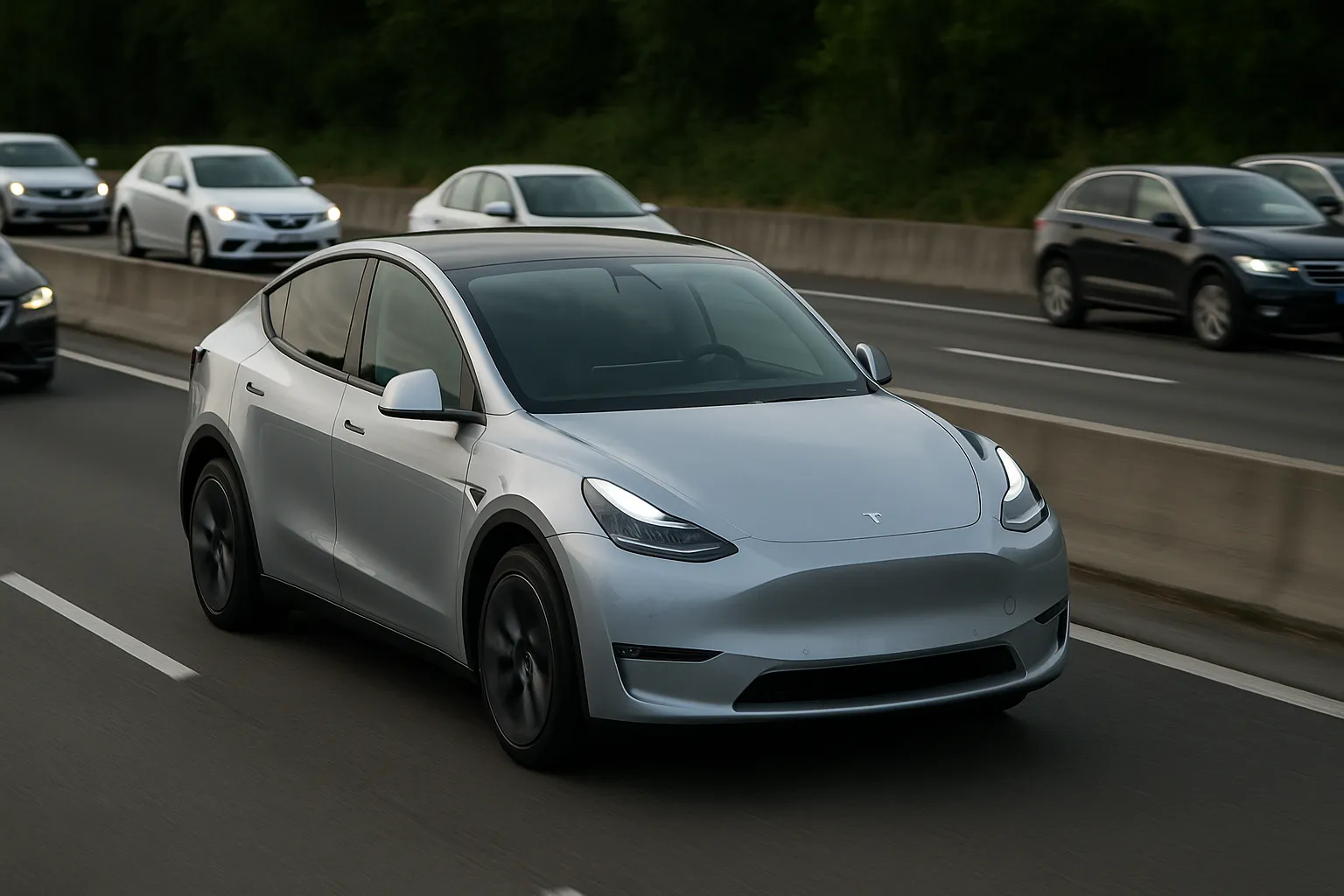
Tesla is further expanding the functionality of its Full Self-Driving driver assistance system. Version FSD v14.3.9 adds a function called Automatic Collision Evasion. In critical situations, it is intended not only to warn, but also to briefly actively influence the vehicle – even when the driver is currently driving manually and FSD has not taken over the driving task.
The core of the new feature: If the system detects an imminent collision, it can steer, brake and, if the situation requires it, also accelerate for a brief moment. This means the function goes beyond conventional emergency braking assistants, which generally mainly reduce speed. Tesla is thus making greater use of the capabilities of its camera and computing platform to choose an alternative path at the last moment.
The classification remains important: This is not a step toward a car that drives without human responsibility. FSD continues to be used as a supervised assistance system. The driver must remain attentive, observe the surroundings and be able to intervene at any time. The new function is intended as emergency assistance, not as a free pass to generally hand over more decision-making authority to the car.
What Automatic Collision Evasion does differently

Many modern vehicles have automatic emergency braking, collision warning or lane-keeping functions. These systems often work in clearly defined scenarios: obstacle ahead, impending rear-end collision, unintended departure from the lane. An automatic evasion function is more complex because it not only has to detect an object, but also has to check whether an evasive movement is safer than braking alone.
This is exactly where the interesting part of the new Tesla function lies. If the vehicle derives from sensor data and motion forecasts that a collision is likely, it can briefly carry out a combination of steering, braking and acceleration maneuvers. Acceleration may initially sound unusual in an emergency system, but it can make sense in certain situations – for example, if a lateral obstacle or a rapidly approaching vehicle is to be avoided and a short burst of forward motion opens up the safer space.
Such interventions must take place extremely quickly, but also very cautiously. Evasion must not lead to a more dangerous subsequent event, such as changing lanes into occupied traffic. That is why it is crucial for buyers and owners how predictable and comprehensible the system is in everyday use. Until independent data and broad practical experience are available, the actual safety effect cannot yet be reliably quantified.
Why the function is also relevant during manual driving

What is particularly remarkable is that the function can be active during manual driving. Many driver assistance systems show their strongest capabilities only when a specific mode is switched on. Here, Tesla is shifting part of the FSD capabilities into background operation: Even when the human controls the accelerator, brake and steering wheel, the software can be available as an additional protective layer.
For Tesla owners, this potentially means greater benefit from the FSD package beyond classic navigation and steering functions. Anyone who does not keep FSD permanently activated could still benefit from parts of the software if a critical situation arises. For prospective buyers, this is a new argument when assessing whether a paid assistance package offers more than comfort functions on the highway or in city traffic.
At the same time, the approach raises questions. An emergency intervention must be clearly recognizable to the driver, must not be confused with normal steering behavior and should not feel surprising in its operation. Especially with systems that can briefly accelerate, trust is important. Tesla will be judged by whether the function intervenes rarely, deliberately and plausibly.
No full autonomy
The name Full Self-Driving has been controversial for years because it can suggest more independence than the system legally and technically offers. The new collision evasion function does not change that. It complements active safety, but does not replace human attention.
In practice, the driver remains responsible for lane choice, speed, traffic observation and reacting to unexpected situations. Automatic Collision Evasion is a safety net for exceptional cases. Ideally, it is intended to help where human reaction time is no longer sufficient or a driver does not recognize a danger in time.
For the industry, the step is nevertheless significant. Vehicles are increasingly being improved via software after purchase. Functions that were previously associated with a new hardware generation or model update can now be rolled out via update, provided the sensors and computing power are sufficient. Tesla has been aggressively using this advantage for years. Other manufacturers are also moving in this direction, though often with slower approval cycles and more regionally limited assistance functions.
Open points on availability and effect
It remains open how widely and in which markets FSD v14.3.9 with Automatic Collision Evasion will become available. The introduction of such functions depends not only on the vehicle software, but also on regional approval rules, local product versions and the specific hardware in the respective car. Buyers should therefore not automatically assume that every Tesla model worldwide will receive the same scope of functions.
The practical effectiveness can also only be assessed after longer use. What matters are not only spectacular individual cases, but data on false alarms, avoided accidents, driver behavior after interventions and situations in which the system deliberately does not intervene. A good safety system does not have to constantly draw attention to itself. In the best case, it remains invisible until it is really needed.
For owners, after such an update it is advisable to take a look at the vehicle settings and the current feature notes in the car. Drivers should know which assistance systems are active, which warnings appear and how the vehicle may behave during an intervention. Precisely because over-the-air updates change the range of functions, this familiarization phase is important.
Significance for buyers and the competition
For car buyers, the evaluation of assistance systems is shifting further. It is no longer just a question of whether a car can maintain distance, center itself in the lane or park automatically. Increasingly, what counts is whether the software correctly assesses dangerous situations and reacts appropriately in an emergency. That can be a real safety argument – provided the function works reliably and is communicated transparently.
For enthusiasts, the new feature shows how strongly modern cars are developing from mechanical products into software-defined platforms. Steering, brakes and drive are no longer influenced only by human inputs or simple controllers, but by complex environmental models. This opens up new possibilities, but also increases expectations for testability, regulation and responsibility.
With Automatic Collision Evasion, Tesla is sending another signal: Active safety is not improved only through additional sensors or stronger brakes, but through software that coordinates existing vehicle capabilities. Whether this function becomes a noticeable step forward in everyday use depends on its real-world reliability. But the approach clearly shows where driver assistance is heading: away from individual warning systems and toward situation-based interventions that are ready in the background and are intended to help at the decisive moment.