Tesla Cybercab set to launch in Austin on September 3
Tesla’s two-seat robotaxi without a steering wheel is moving closer to everyday use in Austin. For customers, the launch remains above all a test case for autonomous mobility, regulation, and future vehicle concepts.
Tesla’s next robotaxi step leads to Austin
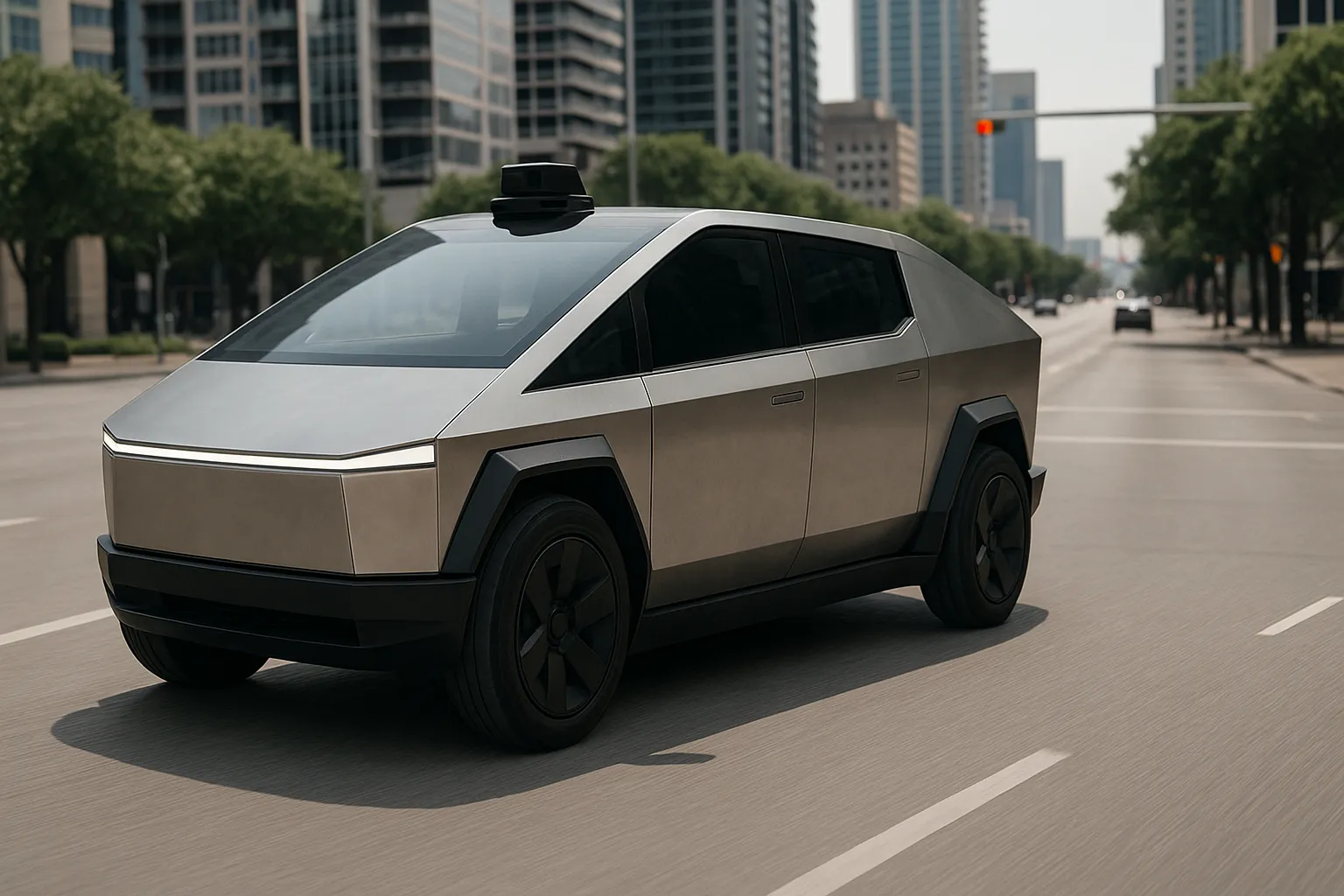
Tesla plans to launch the Cybercab in Austin on September 3. This brings the two-seat robotaxi without a steering wheel to the city where the company is already experimenting with Model Y-based robotaxis. The new step is more than just another local expansion: It shows how Tesla intends to approach the transition from converted production vehicles to a vehicle developed specifically for autonomous ride-hailing services.
For car buyers and owners, the Cybercab is not relevant because it is likely to appear in showrooms as a normal private vehicle in the short term. What matters much more is which technology, which regulatory hurdles, and which business models result from such a deployment. When a car without a steering wheel appears in a real mobility service, the questions shift: It is no longer just about assistance systems, but about the role of humans in the vehicle, approval, liability, safety, and cost per ride.
A robotaxi without a traditional driver role

The Cybercab differs fundamentally from a Model Y used for an autonomous ride-hailing service. A Model Y remains a conventionally operable car: steering wheel, pedals, seating position, and interior layout are designed for a driver. The Cybercab, by contrast, is conceived as a two-seat vehicle without a steering wheel. This eliminates the traditional fallback level in which a human can take control at any time.
That is a major difference technically and legally. A vehicle without manual controls requires autonomous operation to be regarded not merely as a comfort feature, but as the core of the entire vehicle concept. The software must take over driving, the sensors and computing hardware must reliably interpret the surroundings, and the entire service must be designed so that passengers simply get in and are transported.
For enthusiasts, this exact point is exciting. The Cybercab is not another performance derivative, not an SUV, and not a luxury sedan, but a tool for a specific use profile: short to medium-distance rides in a defined area. The vehicle architecture therefore does not follow the usual buying arguments such as range, trunk space, towing capacity, or acceleration, but the goal of transporting passengers as efficiently as possible.
Austin as a test field with signaling effect

Austin is an obvious place for Tesla’s next robotaxi step. The city is close to important company activities and offers an environment in which new mobility services can be introduced in a way that is observable but still controllable. The use of Model Y vehicles as robotaxis has already shown that Tesla did not have to start immediately with a completely new vehicle type. The Cybercab can now serve as the next stage.
Nevertheless, a launch date does not automatically mean that an unrestricted public service for all users will be available immediately. Especially with autonomous vehicles, operating area, operating hours, passenger group, safety processes, and local approvals are decisive. The reference to regulation still following and limited access is therefore central: September 3 marks an important step, but not necessarily the moment when robotaxis without steering wheels become a normal part of the streetscape for everyone.
This limitation is important because expectations for autonomous vehicles have fluctuated for years between ambitious promises and slow market reality. Many drivers are familiar with assistance systems that provide relief on highways but still require attention. A driverless robotaxi goes much further. Authorities and operators will therefore pay particular attention to how stably the system works and how it reacts to construction sites, emergency vehicles, pedestrians, cyclists, and unusual traffic situations.
What does this mean for Tesla owners?
For today’s Tesla owners, the Cybercab is above all a benchmark. Tesla has strongly linked its brand with software, over-the-air updates, and driver assistance. If a specially developed robotaxi works reliably in service, it strengthens the credibility of the autonomous strategy. If access remains limited for a long time or regulatory issues slow down operation, however, that also shows the limits of rapid scaling.
Direct effects on private Model 3, Model Y, Model S, or Model X drivers are not to be expected at first. A Cybercab launch does not replace an approval expansion for private vehicles and does not automatically indicate which functions will be permitted in other markets or on other models. Nevertheless, the project can influence perceptions of Tesla technology. Buyers watch closely whether announced capabilities lead to usable services or whether they remain stuck in narrow pilot phases.
The development can also play an indirect role in resale value and purchase decisions. Anyone buying a Tesla because of the prospect of autonomous driving pays attention to whether the brand is making progress in real-world operation. Those who, by contrast, are looking for an electric car primarily for efficiency, charging infrastructure, and everyday usability will see the Cybercab more as an industry signal than as an immediate reason to buy.
Why regulation remains the bottleneck
A car without a steering wheel presents authorities with different questions than a vehicle with assistance systems. Approval regulations were built over decades around the assumption that a human is driving or can at least take over. If this assumption no longer applies, requirements for system failure, remote support, accident analysis, data storage, and passenger safety must be clearly regulated.
Added to this is the local level. An autonomous vehicle can function in one city under certain conditions but have different risks in another environment. Weather, lane markings, traffic culture, infrastructure, and construction-site density differ considerably. It is therefore plausible that access will initially remain limited and that operation will be expanded in stages.
For the industry, this point is crucial. The biggest hurdle is not building a futuristic-looking vehicle, but proving that it can be operated safely, reliably, and economically in everyday life. Manufacturers, suppliers, insurers, and cities observe such deployments because they provide indications of how quickly autonomous mobility can actually spread.
A new vehicle concept rather than just a new model
The Cybercab does not fit into the usual categories of the car market. It is neither a classic small car nor a coupe for private customers. With two seats and no steering wheel, it is tailored to a service in which use is more important than ownership. In the long term, this may have effects on vehicle design and platform planning.
If autonomous ride-hailing services work economically, manufacturers could develop vehicles differently: less focus on individual equipment packages, more focus on durability, easy cleaning, energy efficiency, fast maintenance, and low operating costs. Interiors could be designed more strongly around passengers, while traditional driver ergonomics lose importance. At the same time, it remains open how great demand for such services will be and whether they are viable outside densely populated areas.
For car enthusiasts, this is a double-edged change. On the one hand, the Cybercab shows a radical technical direction that rethinks the car. On the other hand, the concept moves away from driving as a personal experience. It stands for mobility as a service, not for the car as driver-active property.
Conclusion: Important step, but no overnight breakthrough
The planned launch of the Tesla Cybercab in Austin on September 3 is a significant moment for Tesla’s robotaxi strategy. The vehicle brings the idea of an autonomous ride-hailing service closer to a product developed specifically for it. At the same time, the key questions remain open: How broad will access be? Which requirements will apply? How quickly can operation be expanded? And how reliably does the system work in complex city traffic?
For buyers, owners, and the industry, the significance lies less in a new car that is immediately available than in a practical test for the next phase of mobility. The Cybercab will be measured by whether, beyond demonstrations, it enables a robust, regulated, and economically sensible service. Only then will a striking robotaxi become a real turning point in the car market.