BMW hints at electric M3 with four motors for 2028
BMW is preparing the first fully electric M3: A camouflaged prototype with M colors points to four electric motors, up to around 900 hp, and a market launch around the 2028 model year.
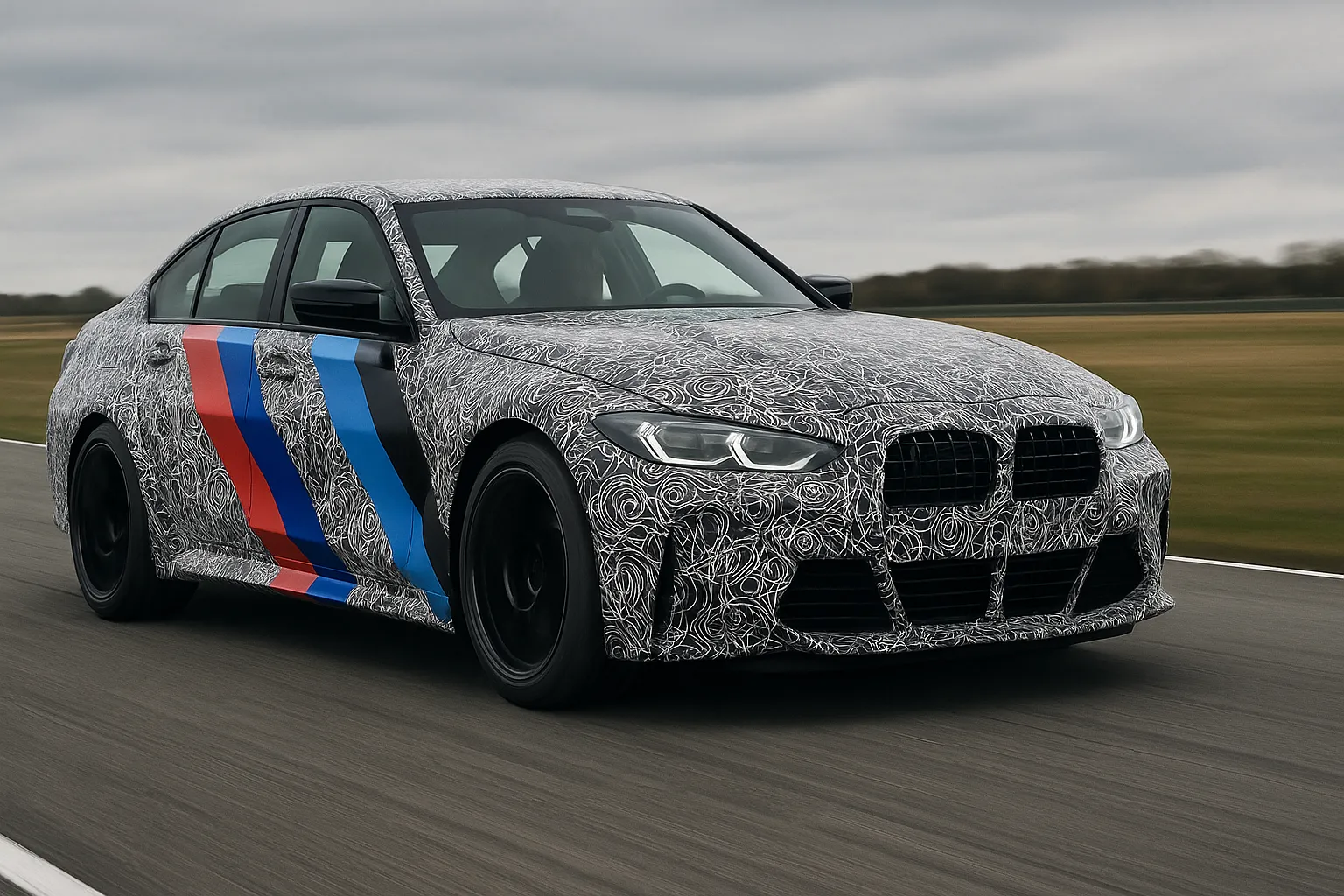
BMW is bringing the first fully electric M3 further into the spotlight. A new teaser shows a still heavily camouflaged sports sedan with the typical M colors and gives a clear indication of where the journey is headed for the brand's most important performance model line: The future M3 is set to compete as an electric car with four motors and reach up to around 900 hp in high-performance versions. The timeframe is around the 2028 model year.
For BMW M, this is more than just another drivetrain variant. The M3 has been one of the defining sports sedans for decades and serves many buyers as a benchmark for everyday usability, driving dynamics, and brand identity. The fact that this particular model is going electric shows how seriously BMW is taking the shift to high-performance electric cars. At the same time, a lot is at stake: An M3 not only has to be fast, but also feel precise, durable, and emotional enough to convince a demanding clientele.
Four motors instead of a conventional drivetrain

The most striking technical indication is the planned quad-motor layout. Instead of a combustion engine at the front and mechanical power distribution via transmission, driveshaft, differentials, and axle shafts, BMW is apparently relying on one electric motor per wheel for the electric M3. This architecture opens up possibilities that a conventional all-wheel drive system can offer only to a limited extent.
With four individually controllable motors, torque can be distributed precisely to each wheel. That can help when accelerating out of corners, stabilizing the vehicle, and varying the self-steering behavior. In theory, such a system can tune a car to be more neutral, more agile, or deliberately more rear-biased without needing mechanical limited-slip differentials in the traditional form. For drivers, however, what ultimately counts is not the number of motors, but the tuning: An electric M3 must respond transparently, be repeatedly fast, and remain thermally stable even on the racetrack.
The stated output of up to around 900 hp is unlikely to apply to every version by necessity. A tiered lineup is probable, as BMW also uses with today's M models. A base version, more powerful Competition variants, or later special models would be conceivable, but have not yet been officially specified. Battery size, range, charging power, weight, and price also remain open.
Why 900 hp is not the whole story

On paper, an output close to 900 hp sounds spectacular, but with electric sports sedans, pure peak power is only part of the overall picture. Continuous output, cooling, battery management, brakes, tires, and software are decisive. A car can be extremely powerful for short acceleration figures, but quickly reach its limits on a long mountain pass or on a circuit if the battery and drive system become too hot.
This is exactly where the credibility of an electric M3 will be created or fail. BMW M did not build its reputation on sprint times alone, but on chassis work, steering feel, balance, and durability. The switch to electric drive changes the task: More mass from the battery has to be controlled, recuperation has to feel natural, and the software has to give the driver confidence instead of merely masking interventions.
A quad-motor system can help here because it can meter drive torque very precisely. But it can also become complex and expensive. Buyers therefore face the question of whether the additional technology brings noticeable advantages in everyday use or primarily marks the technical peak of the model line.
An M3 for the next electric generation
The planned timing around the 2028 model year fits BMW's broader electrification strategy. The brand is working on a new generation of electric vehicles in which efficiency, software, battery technology, and charging capability are intended to become more important than in the early converted combustion-engine platforms. An electric M3 is likely to benefit from this development, even if BMW has not yet released all the technical key data.
For the market, the timing is important. By 2028, performance electric cars will be competing for customers much more strongly than they do today. Sedans with very high performance are already no longer a novelty, and established sports car brands are also electrifying their offerings. BMW therefore has to deliver more than a high horsepower figure: The electric M3 must clearly stand apart as an M model, not just as a fast battery sedan with a familiar name.
The naming question is also likely to play a role. BMW has not yet disclosed in every detail what the electric M3 variant will ultimately be called and how it will be positioned alongside possible combustion-engine or hybrid models. For enthusiasts, this is relevant because the M3 name has a long history. Too strong a departure from the familiar character could be viewed skeptically; a convincing reinterpretation, on the other hand, could win over new customers and bring existing fans along.
Significance for buyers and owners
For potential buyers, an electric M3 changes the calculation. Anyone who previously chose an M3 for its sound, shifting feel, or inline-six character will have to weigh whether the advantages of an electric drive compensate for the loss of classic appeal. These include instant torque, potentially lower everyday operating costs, quiet driving, and the ability to charge at home.
At the same time, practical questions remain open: How far can the car go when driven sportily? How quickly does it charge on long-distance trips? How much do weight and tire wear affect running costs? And how will the resale value of such a powerful electric M model develop? Without final specifications, these points cannot yet be answered seriously.
For today's M3 owners, the new electric M3 could nevertheless become interesting if BMW retains the familiar everyday usability. A four-door body, usable interior, and a broad range of abilities have always been part of the recipe. If the electric successor combines these qualities with precise driving dynamics and reliable fast-charging capability, it could be not only a technology flagship, but a real replacement for classic performance sedans.
A signal to the industry
The teaser also shows how the performance class is shifting. In the past, engine building, transmission tuning, and mechanical differentials were at the center. In the future, power electronics, battery cells, software control, and thermal management will be at least as important. Manufacturers that want to sell sports sedans will therefore have to prove their expertise anew.
With the electric M3, BMW M has the chance to actively shape this transformation. But the step is demanding because the M3 is not just any model. It stands for a set of expectations that cannot be met by acceleration figures alone. The coming details on weight, range, charging power, chassis concept, and price will show whether the electric M3 becomes only the most powerful new M sedan or also the most convincing one.
Until then, the teaser remains above all a clear promise: BMW is preparing an electric M3 generation that technically goes far beyond a simple platform change. Four motors and up to around 900 hp point to an ambitious concept. Whether it becomes the new benchmark for electric sports sedans will only be decided when the production car reveals its data, its driving behavior, and its everyday usability.