Ferrari 296: Challenge Stradale and Challenge Evo revealed
Ferrari is showing two new 296 derivatives: a road-legal Challenge Stradale without hybrid assistance and the Challenge Evo for the one-make series from 2027.
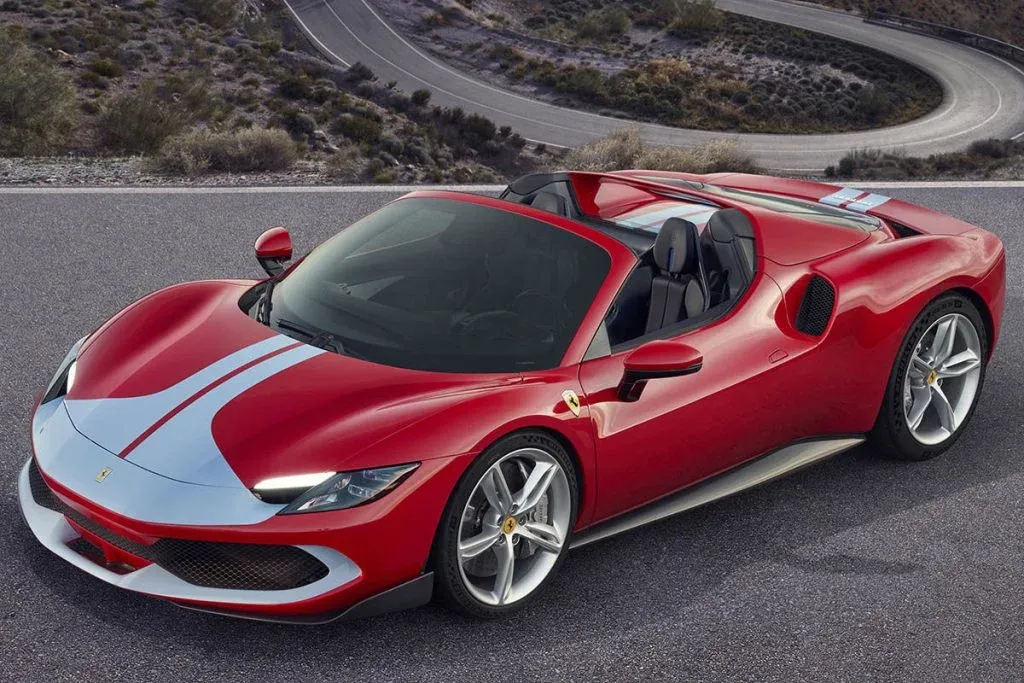
Ferrari has presented two new models based on the 296 at the Finali Mondiali at the Circuit de Barcelona-Catalunya. The 296 Challenge Stradale brings racing technology to a road-legal car, while the 296 Challenge Evo is intended exclusively for track use and is due to replace the current 296 Challenge in the one-make series from the 2027 season. Both models dispense with electric assistance and use a twin-turbo V6 with rear-wheel drive. Ferrari has not yet named prices or a specific market launch for the 296 Challenge Stradale.
296 Challenge Stradale: road approval without hybrid assistance
The 296 Challenge Stradale uses the familiar 2,992-cubic-centimetre twin-turbo V6 with a 120-degree cylinder bank angle. It produces 670 PS at 8,000 rpm and delivers 740 Nm at 6,250 rpm. Power is transmitted by an eight-speed dual-clutch gearbox that has been adapted for the new powertrain. Under high load and at high engine speed, it uses a shift strategy derived from the 296 Challenge; shift times are then around 170 milliseconds. With the hybrid components removed and further lightweight measures applied, dry weight is 1,330 kilograms, 140 kilograms less than the 296 GTB. Ferrari quotes 2.8 seconds for 0 to 100 km/h, 7.9 seconds to 200 km/h and a top speed of more than 300 km/h.
- The aerodynamics have been extensively changed: the front splitter, air-guiding elements, openings in the front bonnet, underbody, rear diffuser and a large fixed rear wing together generate 617 kilograms of downforce at 250 km/h. That is 72 percent more than on the 296 GTB; the rear wing alone contributes 270 kilograms.
- The chassis receives adapted spring rates and semi-active dampers. Compared with the 296 GTB, Ferrari claims seven percent higher maximum lateral acceleration, 34 percent more stability and a 68 percent reduction in roll tendency.
- The braking system uses carbon-ceramic discs measuring 398 millimetres at the front and 380 millimetres at the rear. ABS Evo is available in all driving modes. Pirelli P Zero R and P Zero Trofeo RS tyres were developed for track use. Ferrari gives the Fiorano lap time as 1:18.5 minutes.
- Inside, carbon door panels without armrests or storage compartments, lightweight carbon seats, optional forged wheels and, on request, the removal of further trim parts serve to reduce weight. Road equipment includes adaptive cruise control, emergency braking assistance, lane-keeping functions and Matrix LED headlights, among other features.
296 Challenge Evo: race model from 2027
The 296 Challenge Evo is based on the 296 Challenge used since 2024, is not permitted on public roads and has been revised mainly in aerodynamics and vehicle dynamics. Its twin-turbo V6 produces 700 PS at 7,500 rpm and 740 Nm at 6,000 rpm, with shifting handled by a seven-speed dual-clutch gearbox. Dry weight is also 1,330 kilograms. There are two basic configurations for different circuits: High Downforce and Low Drag. In the High Downforce setup, maximum downforce at 250 km/h increases by twelve percent, or around 100 kilograms, compared with its predecessor. In the Low Drag configuration, the rear wing is set flatter and certain front add-on parts are removed; drag falls by four percent. The front splitter, underbody, rear diffuser and rear-wing mounts were among the parts revised.
Use in the Ferrari Challenge
Ferrari has also adjusted the traction control, electronic differential and brake feel of the 296 Challenge Evo. A longer pedal travel and higher pedal force for the same deceleration are intended to improve modulation and reduce tyre wear over longer race distances. A new instrument display shows, among other things, interventions by the vehicle dynamics systems, tyre pressure and lap times. In comparison runs at Mugello, Ferrari says the Evo in High Downforce configuration was 0.8 seconds faster than the previous 296 Challenge. Use is planned from 2027 in the European and North American Ferrari Challenge series, with regional championships to follow from 2028. In Europe, Ferrari is adding an endurance format to the calendar with events at Mugello, Hockenheim and Valencia: the races last 40 minutes plus one lap, two drivers can share one car, and a pit stop is mandatory.